


He was a twin brother of Zethos. The two children were born from Zeus and Antiope, the daughter of the god river Asopos . Their mother gave birth to mount Kithairon and they were raised by shepherds.
Ancient Greeks considered him one of the greatest musicians of the time. They were saying that his brother Zithos had brought huge stones to Thebes. Amphion began playing his seven-string lyre with such an enchanting way that the stones were assembled on their own. Thus, the famous walls of Thebes with the seven gates, as well as the strings of the lyre, were built.
The two brothers killed the king of Thebes Lykos, because he tortured their mother, and they took his kingdom. Amphion married Niobe and had six sons and six daughters. They were both very proud, because they had many children and they spoke contemptuously about Leto, who only had two children with Zeus, Apollo and Artemis. For their arrogance they were severely punished. Apollo killed their boys and Artemis the girls.

He was the son of the oracle Amphiaraus and Erifili. He was one of the Epigoni, one of the children of the Seven Generals, who had also campaigned against Thebes.
In this campaign he took part to avenge the death of his father. He excelled in the battlefield and killed the King of Thebes, Laomedon, son of Polyneikes.
When he returned from this campaign, he killed his mother to punish her for her double treason, betrayal against him and against his father. Polyneikes son of Oedipus wanted to campaign against Thebes. His purpose was to claim the throne from his brother Eteocles. So he asked for the help of the Seven Generals, among them Amphiaraos. He initially refused to take part, because, as an oracle , he knew that from all the leaders only Adrastos would return alive. But his wife, Erifili, persuaded him, and here’s why: Polyneikes had promised that if she could persuade her husband to take part in the campaign, he would give her the famous necklace of Harmony. So it happened. Amphiaraus was persuaded, but ordered his sons to kill their mother after the unfortunate end of the war and to campaign against Thebes. But in this case Erifili also betrayed her own. This time, she received the veil of Harmony from the son of Polyneikes Thersandros to persuade her sons to take part in the Epigonian campaign. After the fall of Thebes, Alkmaion killed her, when he learned of the bribe. It was natural for Erinyes to persecute him for this murder. That is why he had to resort to the king of Arkadia, Phigeas. He helped him to purify himself from the murder of his mother and gave him his daughter Alphesivoea or Arsinoe for wife. Erinyes , however, continued to persecute him.
He then asked for a sign from the oracle. He was advised to go to a country that had not seen the sunlight when he killed his mother. Thus it was found in the estuary of Acheloos River, where the land around was formed by the floods of the river after his crime. There, he was purified for the second time and Acheloos gave him his daughter Kalliroe for wife. She begged him to bring her the veil and necklace of Harmony, taken by his mother Erifili, as a reward for her double betrayal. Alkmaion, however, had given them to Alphesivoea, the daughter of Fygeas. On the pretext that he wanted to dedicate them to Apollo, he took them back. But Fygea's sons killed him in ambush. However soon enough they also found death from the sons of Alkmaion, Acarnanas, and Amphoteros, who suddenly became men.

Actaeon had been trained as an excellent hunter by the wise and courageous centaur Chiron. The story of Actaeon is known, however, not for his skills as a hunter, but because he ended up prey to his dogs when he was transformed into a male deer.
Actaeon's father was Aristaeus, the son of Apollo, and his mother Autonoe, the daughter of the first king of the Thebes, Cadmus. There are four basic versions of the myth of Actaeon. The most famous is found in the "Transformations" of the Roman poet Ovid. It is a collection of stories and myths, many of which relate to the transformation of humans into animals and plants.
According to Ovid, Actaeon hunted one day in the woods when he met the goddess Artemis and her nymphs following her bathing in a secret spring on Mount Kithairon. Artemis was a strict protector of the purity and virginity of her followers, so when she caught Actaeon looking at her naked body, she was outraged.
To avenge him,the goddess threw at him a few drops of water, turning him into a male deer. His own dogs did not recognize him, they got him into the hunt, and when they caught him, they tore him apart. After his death, the hunter's dogs were constantly screaming about their lost master.

Their
cries made the Centaur Chiron to feel sorry for them. He made a statue
out of his old student, which looked so alive that the dogs believed he
was really their master, so they stopped howling.
In the second of the four most popular versions of story, the king of the gods of Zeus killed Actaeon because he flirted with his aunt Semeli, whom Zeus wanted for himself. In a third variation of the myth, Actaeon caused Artemis's wrath when he claimed to be a more capable hunter than her, while in the fourth version he asked Artemis to become his wife. The result in the last two cases was the same as the first: The goddess transformed Actaeon into a male deer, making him a prey and causing his death.
Aeneas was a Trojan hero of Greek mythology, a prince son of mortal Anchises and goddess Aphrodite. In addition, Aeneas was the legendary founder of the Roman race.

Though Troy was in Asia Minor, it was fully influenced by Greece, Greek culture, as it was an old commercial colony of Greeks in the region. So although many of the Trojans were not considered Greeks, they married Greeks, had Greek cus, spoke Greek, worshiped the same gods, even their royal generation was descended from the king of gods, Zeus. Aeneas is said to be the son of the goddess Aphrodite. The main source of Aeneas' stories is Eneada, written by the Roman poet Virgil, but there were many other legends in the Greek world.
Venus did not choose Anchises as a lover. Their union was arranged by Zeus as a punishment because he accused her of using her power on him to fall in love with mortal women. Aphrodite was ashamed of her union. She forbade Anchises to talk about it, but she vowed that their son would become a great hero. After the birth of Aeneas, nymphs took care of him, and brought him up until he grew up enough to become a warrior.

Aeneas matured at the beginning of the Trojan War. There is the opinion that Aeneas as well as other heroes, including Achilles and Odysseus, are transient figures standing at the brink of a change in people's culture. After the Trojan War, the demigods such as Aeneas and Achilles would cease to influence the fate of the nations, and also the world would no longer be "inhabited" by the supernatural monsters and witches Aeneas and Odysseus were facing on their journeys.
When the Achaeans besieged Troy, Aeneas helped defending the city as the leader of a group of Trojan allies called the Dardans. He was one of the most prolific defenders of Troy, although he was forced to flee by the supreme Greek warrior, Achilles, when in more than one cases he escaped death with the intervention of the gods. Although Aeneas and Priam were on the same side, there was a friction between them. The antipathy between them is due to the suggestion that Aeneas made, that the Trojans should capitulate with the Achaeans. In any case, when the Achaeans invaded Troy, Aeneas, unlike other Trojan warriors, either escaped or was allowed to leave. The hero, taking his elderly father to his shoulders, and his little son Ascanio by hand, led a group of survivors away from the ruined city. But in confusion he lost his wife, Kresa.
Wandering in the Mediterranean
The Trojan fugitives wandered for years in search of a new homeland. As during the Trojan War, goddess Aphrodite helped them, while goddess Hera continued the war against the Trojans. During these voyages the Trojans suffered, some died because of the storms and hardships, and failed several times to establish a new city. They met other survivors from Troy, but they could not escape its tragic fate.
According to the stories, the Trojans initially tried to establish the city of Aenea in Thrace, but they were prevented from doing so by terrifying omens. When they were sailing again they arrived at the island of Delos. There they were advised by the oracle of Apollo, to find their "first Mother". Anchises concluded that he probably meant the island of Crete, the original homeland of the royal generation of the Trojans. When they arrived there, the Trojans attempted to establish a town called Pergamon, as Troy had previously been called. However, when the Trojans were hit by a plague, they realized that this was probably the first homeland of another part of the royal family, originating in Italy.
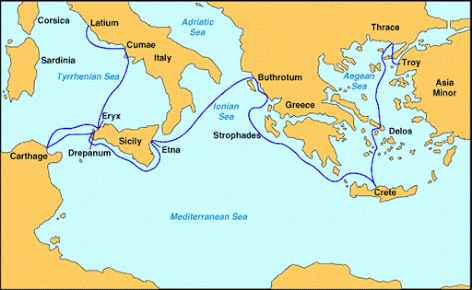
Traveling to the west, the Trojans stopped on the islands where they encountered the Arpiyes, the frightened female monsters that had fought with Jason and the Argonauts. Continuing their journey, they were found in Aktio, on the west coast of Greece, where they held athletic games in honor of Apollo. The next step of their journey brought them to Bouthroto, northwestern Greece, where they met the oracle lord Elenos, the only living son of Priam. Elenos gave Aeneas important information about the rest of his trip. Sailing for Sicily, the Trojans tricked the Cyclops and avoided Scylla and Charybdis, who had caused problems in Odysseus. At the next stop Drepanos, Anchises died of natural causes. As they sailed to the mainland of Italy, the goddess Hera sent a terrible storm that plunged many Trojan ships, while the rest were drifted to Carthage on the shores of modern Tunisia.
In North Africa, the Trojans were invited to join a colony of the Phoenicians, governed by Queen Dido.
Aeneas fell in love with Dido, but the gods reported to him that the fate of the Trojans was not to unite with the Phoenicians, but with the Italians. So Aeneas with great reluctance sailed away. He left in the middle of the night, and when Dido learned it, she swore an eternal struggle between the Carthaginians and the future Romans, and then committed suicide.
Aeneas fell in love with Dido, but the gods reported to him that the fate of the Trojans was not to unite with the Phoenicians, but with the Italians. So Aeneas with great reluctance sailed away. He left in the middle of the night, and when Dido learned it, she swore an eternal struggle between the Carthaginians and the future Romans, and then committed suicide.
 The Trojans arrived again in Italy. Returning initially to Sicily, they conducted racing games to honor Anchises. After the games, the Trojans, tired of wandering, set fire on the ships, but Aeneas prayed in Zeus to send rain so that only four boats were burned. Arriving in Kymi (near modern Naples), Aeneas consulted the fortune-teller Sivilla who sent him to the Under World after leading him to bring a golden branch from a sacred forest. In the Under World, Aeneas faced the ghosts of his former rivals and allies, as well as the shadow of his father, who showed him the glorious future of Rome. Guided by Anchises and other divine oes, the Trojans insisted until they found the estuary of the Tiber River.
Approaching the end of the journey
Though they had reached the promised land, the Trojan suffering was not over. Aeneas tried to make a treaty with the inhabitants of the Tiber region, the Latins, whose King Latino was of Greek descent. Latin initially agreed to an alliance, and promised his daughter Lavinia to Aeneas. However, he had earlier called it to Turnos, prince of the Rutylons, who led by Hera threatened with war. Then Aeneas found an ally, king Evander, of another Greek colony of Arcadians who had settled near the future location of Rome.

The Death of a Hero
Enraged at Pallas' death, Aeneas killed Turno in battle. With their supreme warrior dead, the Latin alliance was dissolved and begged for peace. Hera finally accepted the Trojan presence in Tiber. Aeneas married Lavinia, who for some became Jules' mother. Perhaps she was also the mother of Aeneas’ daughter, Ilias. Aeneas reigned a people mixed with the Trojans and Italians and founded a new city called Lavinio, near the future location of Rome, which was later established by the descendants of Aeneas, Rome and Romulus.
Aeneas died just three years after arriving in Italy. Some versions say he was killed in the battle, while others, he just disappeared after his victory. After his death, Aphrodite pleaded with the other gods and made her son immortal, as did other heroes like Hercules.
Aeneas died just three years after arriving in Italy. Some versions say he was killed in the battle, while others, he just disappeared after his victory. After his death, Aphrodite pleaded with the other gods and made her son immortal, as did other heroes like Hercules.


